An e-passport, also known as an electronic or biometric passport, is a secure travel document with an embedded microprocessor chip and antenna.
It stores your personal details, digital photograph, and, where applicable, biometric information such as fingerprints and/or an iris scan.
According to the International Civil Aviation Organization (ICAO), e-passports are widely used around the world, with more than 180 countries issuing them and over one billion in active circulation as of 2026.
So, how does an e-passport work? How can you identify one, and what are the benefits of having an e-passport for Qatar travelers? In this blog, let us explore everything you need to know about e-passports and how they make international travel more secure and convenient.
Gentle Reminder: The Visa Guy does not provide passport or e-passport services. We provide visa services for more than 100 countries, including the U.S., UK, and Schengen countries. If you need assistance with a visa application, you can contact our visa consultants for guidance on the relevant requirements and application process.
What Is an ePassport?
The electronic passport, commonly known as an e-passport, was first introduced in Malaysia in 1998. Malaysia became the first country in the world to issue an electronic passport.
However, its initial system was based on a proprietary design and was introduced before international e-passport specifications had been established.
In 2003, the International Civil Aviation Organization (ICAO) adopted specifications for machine-readable travel documents (MRTDs) that included an embedded electronic chip containing the passport holder’s personal information and photograph.
In 2004, Belgium became the first country to issue an ICAO-compliant e-passport. The United States began issuing e-passports in 2006.
By 2009, e-passports accounted for about 57% of all passports issued worldwide. By 2013, around 100 countries were issuing e-passports, with nearly 400 million e-passports in circulation globally.
Today, e-passports have become an important part of international travel and border security. But how are they different from traditional passports? Let’s look at the key differences.
| Feature | Traditional Passport | E-Passport |
| Basic format | Physical passport booklet | Physical passport booklet with an embedded electronic chip |
| Electronic chip | Does not contain an electronic chip | Contains a contactless microprocessor chip and antenna |
| Personal information | Printed on the passport’s data page | Printed on the data page and certain information is also stored electronically on the chip |
| Digital photograph | Printed photograph | Printed photograph, with a digital facial image stored on the chip |
| Biometric information | Generally not stored electronically in the passport itself | Biometric information may be stored electronically according to the issuing country’s system and applicable standards |
| Machine-readable zone (MRZ) | May have an MRZ | Has an MRZ and an electronic chip under ICAO ePassport standards |
| Electronic verification | Cannot be electronically authenticated through a passport chip | The chip can be authenticated electronically to verify the document’s authenticity and integrity |
| Border control | Usually requires manual document checks or scanning of the MRZ | Can be read electronically by compatible border-control systems and may support automated border processing |
| Security | Relies mainly on physical security features and document inspection | Combines physical security features with electronic security and chip authentication |
| Risk of alteration | Printed information can be targeted for physical alteration or forgery | Electronic data is protected by digital security mechanisms designed to help detect unauthorized alteration |
| International standards | May follow applicable passport and MRTD standards without having an electronic chip | ICAO-compliant e-passports follow international specifications for electronic machine-readable travel documents |
| Visual identification | Identified through the passport’s physical security features and data page | Can be identified by the ePassport symbol on the cover and verified through its electronic chip |
| Use for international travel | Can be used for international travel if valid and accepted by the destination country | Can be used for international travel, subject to the same visa, entry and passport-validity requirements applicable to the traveler |
Myth: An e-passport is a digital passport that you can store and use on your phone.
Fact: An e-passport is still a physical passport booklet. The difference is that it contains an embedded electronic chip that securely stores certain passport information and allows authorised border-control systems to electronically verify the document.
So, having an e-passport does not mean you can travel without carrying your physical passport. You still need to carry your valid passport when travelling internationally.
How Does an ePassport Work?
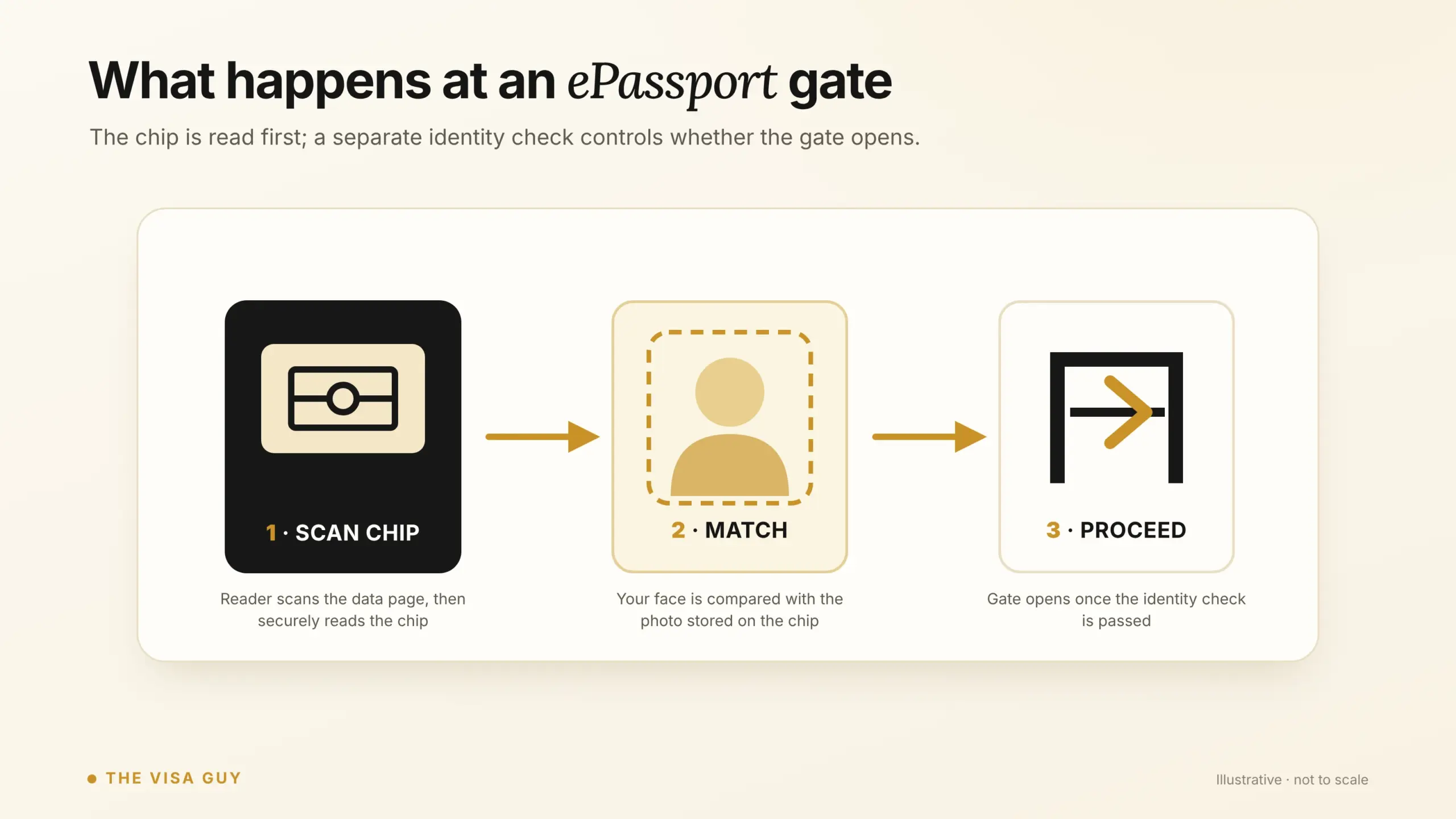
An e-passport works like a regular passport but has an embedded electronic chip. The chip stores important passport information and a digital photo of the passport holder. When you travel, authorised passport readers can access this information wirelessly and verify that the passport is genuine and has not been altered. At some border crossings, the system can also compare your face with the digital photo stored in the chip.
Key Features of an E-Passport
- Embedded chip: A small electronic chip is built into the passport booklet.
- Contactless technology: The chip can be read wirelessly by compatible passport readers.
- Digital photo: A digital image of the passport holder is stored on the chip.
- Security features: The chip uses electronic security measures to help protect the stored information.
- Digital signature: The issuing authority digitally signs the chip data to help verify that it is genuine.
Information Stored in an E-Passport
An e-passport can store information such as:
- Full name
- Date of birth
- Nationality
- Passport number
- Passport validity details
- Digital facial photograph
- Other information required under applicable international standards
Additional biometric information, such as fingerprints, may be included depending on the country and its passport system.
When you present your e-passport at an airport or border checkpoint:
- The passport reader scans the Machine Readable Zone (MRZ) on the data page.
- The reader uses this information to securely access the chip.
- The chip sends its stored information to the authorised reader.
- The system checks the digital signature to verify the passport’s authenticity.
- At automated border gates, your face may be compared with the digital photograph stored on the chip.
This process helps border authorities verify the passport and confirm that the electronic information has not been altered.
How to Identify an ePassport
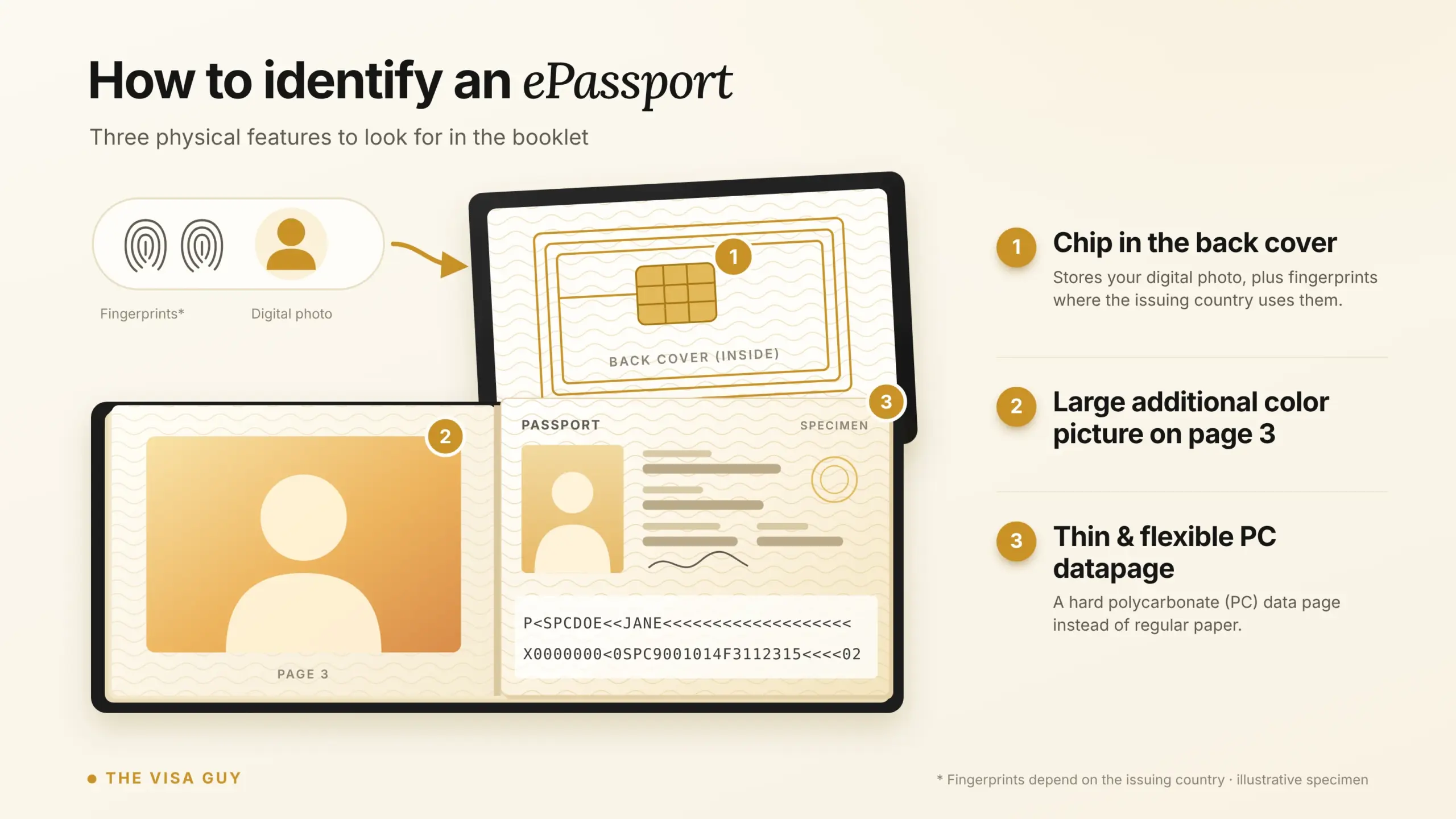
You can usually identify an e-passport by checking a few physical signs on the passport booklet. Look for the following:
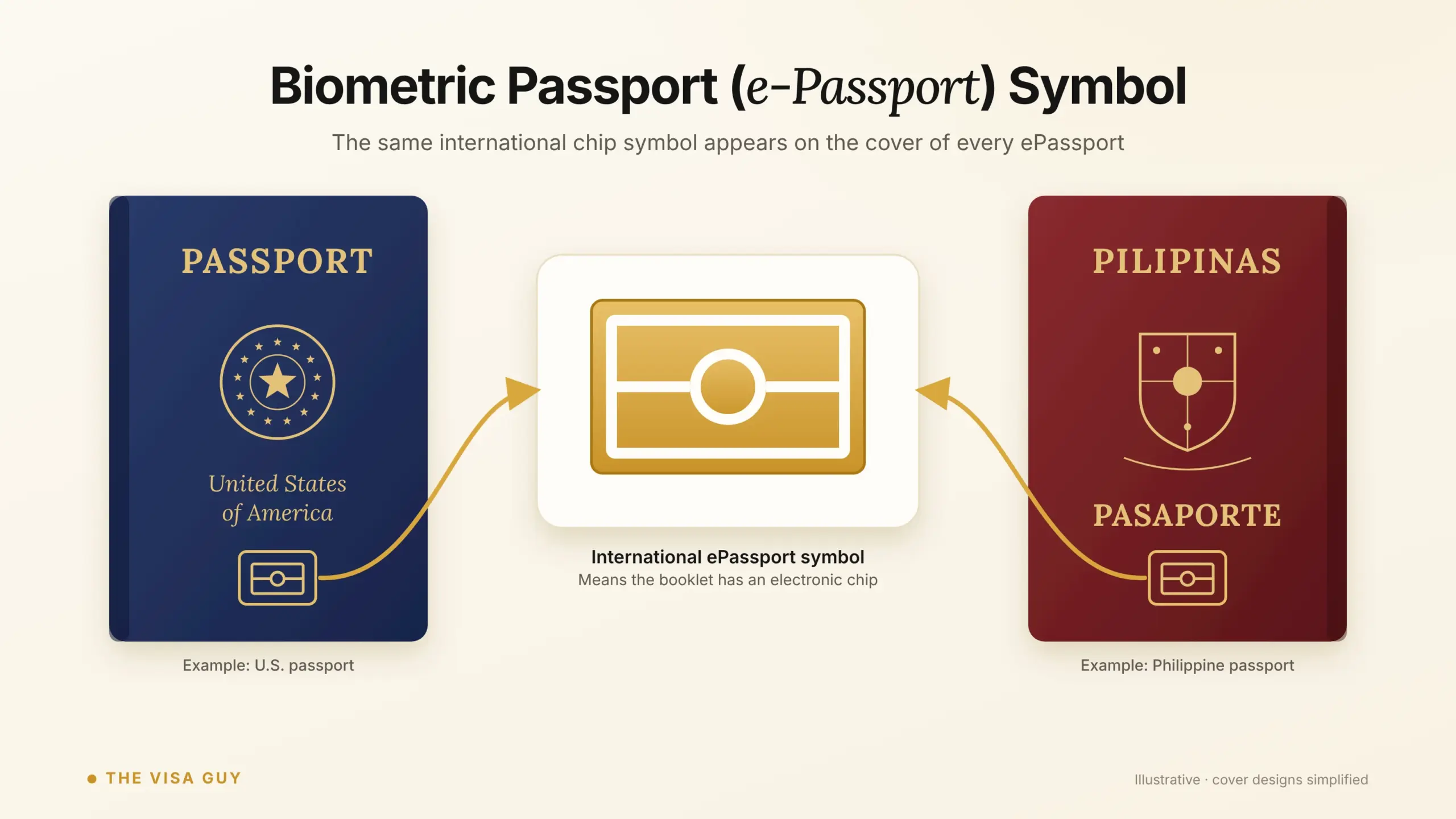
- ePassport symbol: Check the front cover for the international ePassport symbol. This indicates that the passport contains an electronic chip.
- Electronic chip: You cannot usually see the chip because it is built into the passport cover or data page.
- Flexible data page: Some e-passports have a hard, plastic data page instead of a regular paper page.
- Laser-engraved details: Some passports use laser engraving for the photograph and personal details. This makes the information harder to alter.
- Machine Readable Zone (MRZ): Check the bottom of the passport’s data page for two lines of letters, numbers, and symbols. This is the Machine Readable Zone used by passport-reading systems.
Tip: The ePassport symbol on the cover is the easiest way to identify an e-passport. The exact design and security features can vary depending on the country that issued the passport.
Benefits of an ePassport for Qatar Travellers
An ePassport offers several benefits when you travel internationally from Qatar:
- Faster Immigration Processing: Automated border gates can read the chip and verify your passport electronically. This may reduce processing time at supported airports.
- Improved Security: The electronic chip and digital security features help protect your passport information and make unauthorised changes easier to detect.
- Easy Electronic Verification: Border authorities can verify the passport electronically instead of relying only on the printed information.
- Access to Automated Border Gates: Some airports and countries allow eligible ePassport holders to use automated immigration gates. Availability depends on the destination and the traveller’s eligibility.
- Global Use: E-passports follow international standards, which allows compatible border systems in many countries to read and verify them.
- Better Protection Against Fraud: Digital signatures and other security features help authorities check whether the passport is genuine and the chip data has been changed.
- Convenient International Travel: E-passports can make document checks smoother at airports and other international border points that support ePassport technology.
Does an ePassport Mean You Can Travel Without a Visa?
No. An ePassport does not give you automatic visa-free entry to another country. Your nationality and the destination country’s rules determine whether you need a visa.
- An ePassport is not a visa: Having an ePassport does not mean you can enter every country without a visa.
- It may be required for visa-free travel: Some countries require an ePassport to use certain visa waiver programs.
- Visa rules still apply: If your nationality requires a visa for your destination, you must apply for the required visa or e-visa even if you have an ePassport.
- Check the destination rules: Visa and entry requirements vary by country. Always check the current requirements before you travel.
Can Qatar Residents Get an ePassport?
Qatari Nationals
Qatari citizens can apply for and hold a Qatari ePassport. The passport contains an electronic chip with biometric information.
Expatriate Residents
Expatriate residents cannot get a Qatari passport. They must obtain an ePassport from their own country if that country issues one. They can usually apply through their country’s embassy or the relevant passport authority in Qatar.
The process and requirements vary by nationality. Check with your country’s embassy in Doha for the latest information.
Tips for Travelling With an ePassport
- Check your ePassport: Look for the ePassport symbol on the cover. Make sure your passport is valid and in good condition.
- Protect the chip: Avoid bending or damaging your passport. Keep it away from conditions that could damage the electronic chip.
- Remove the passport cover: Take off thick passport covers before using an automated border gate. Follow the instructions on the scanner.
- Keep your passport with you: Carry your ePassport in your hand luggage or personal bag. Do not put it in checked baggage.
- Use eGates when eligible: Some airports allow eligible travellers to use automated eGates. Check the airport’s rules before using one.
- Follow the scanner instructions: Place your passport on the reader as shown on the screen. Different eGates may use different scanning methods.
- Look at the camera: Remove sunglasses, hats, or other items that cover your face. Look straight at the camera when asked.
- Stay still: Keep your face in the correct position until the system completes the check.
- Follow immigration instructions: If the eGate does not work, follow the instructions and speak to an immigration officer if needed.
- Check entry requirements: An ePassport does not replace a visa or other travel documents. Check the destination country’s requirements before you travel.
ePassport: A Note for Qatar Residents
An ePassport can make international travel more secure and easier to manage. But travellers should still check their passport validity, visa requirements, and entry rules before every trip.
Some countries also require a minimum period of passport validity or a certain number of blank pages.
Keep your passport details consistent across your visa application, flight booking, and other travel documents.
If you renew your passport, check whether you need to update your visa, travel authorisation, or other linked records.
Basically, your ePassport supports secure identity checks, but your travel requirements still depend on your nationality and destination. Check the latest rules before you travel to avoid delays at the airport or border.
Please note: The Visa Guy does not provide ePassport or passport services. For ePassport-related services, please contact your concerned embassy or passport authority.
For visa applications from Qatar, The Visa Guy provides visa-related assistance for various destinations. Explore our visa services and contact us for assistance with your visa application and related requirements.
FAQs
What happens if the chip inside my ePassport is damaged?
If the chip is damaged, the ePassport may not work with electronic passport readers or eGates. However, the printed details may still be readable. If you suspect chip damage, contact your passport authority before travelling.
Can I still travel if my ePassport chip stops working?
A damaged or non-working chip does not automatically mean you cannot travel. Border authorities may be able to verify your identity using the printed information and other checks. However, requirements vary by country, so check with the relevant passport or immigration authority before travelling.
How long is an ePassport valid?
The validity period depends on the issuing country and the passport holder’s age. Check the expiry date printed on your passport. Some countries also require your passport to remain valid for a certain period beyond your planned travel dates.
Can I renew my passport as an ePassport?
This depends on your country of citizenship and its passport system. If your country issues ePassports, you may be able to receive an ePassport when you renew your passport. Check with your embassy or passport authority for the current renewal process.
Can children get an ePassport?
Yes, many countries issue ePassports to children. The application requirements, biometric information, parental consent, and validity period can differ for children. Check the requirements of your country’s passport authority before applying.