An IC card, or Integrated Circuit card, is a prepaid and rechargeable smart card used to pay for public transport and make small purchases in Japan.
Qatar residents travelling to Japan can use IC cards on many trains, buses, and at participating shops, vending machines, and other services that accept IC card payments. . You can also use digital versions of some IC cards on your smartphone, depending on the type of phone you use.
In this blog, we explain how IC cards work in Japan, the different types of IC cards available, how to use them, and what Qatar residents should know before their trip.
The Visa Guy is a visa service agency in Qatar. We do not provide IC cards, but we assist Qatar residents with Japan visa applications and other visa services. For Japan visa assistance, you can contact The Visa Guy for more information.
What Is an IC Card in Japan?
A Japan IC card is a rechargeable smart card that makes travelling and making small payments more convenient.
You can use it to pay for train and bus journeys and, at participating locations, for purchases at convenience stores, vending machines, station lockers, and some restaurants. Depending on the card and your smartphone, you may also be able to use a digital version through a mobile wallet.
For public transport, you simply tap the card at the ticket gate when you enter and tap it again when you exit. The system records your journey and automatically deducts the applicable fare from your balance. This means you do not have to buy a separate ticket for every journey.
One of Japan’s best-known IC cards, Suica, was introduced by JR East in November 2001 as a fare collection system designed to replace magnetic tickets.
JR East later expanded Suica beyond transport, launching its electronic money service in March 2004 so passengers could also use it for small purchases at participating stores and vending machines.
IC cards have since become an important part of everyday travel in Japan.According to GlobalData, Japan’s card payments market is forecast to reach JPY 134.9 trillion (US$892.5 billion) in 2025, representing 9.6% growth from the previous year.
Now, let us look at how IC cards work, the different types available in Japan, and what Qatar residents should know before using one during their trip.
How Do IC Cards Work?
- Contactless technology: IC cards use contactless technology to communicate with a card reader. When you place the card close to the reader, the card and the terminal exchange information without physical contact.
- Information stored on the card: The card contains an electronic chip that securely stores information needed to process transactions. The system can update the card’s balance after you make a payment.
- Fast processing: The reader can process the card in a fraction of a second. This allows passengers to move through busy station gates quickly without stopping to handle cash or paper tickets.
- Automatic fare calculation: When you use an IC card for transport, the system records the relevant journey details and calculates the applicable fare based on the transport operator’s fare system.
- Secure payments: IC cards use secure communication between the card and the reader to process transactions. This helps protect the information stored on the card during use.
- Works across participating networks: Many major IC cards have mutual-use arrangements with other transport networks. This allows a card issued in one region to work on participating services in another region, although coverage and rules can vary.
- Offline-style convenience: A physical IC card does not need a mobile internet connection every time you use it. The card and reader can communicate directly to process the transaction.
Types of IC Cards in Japan
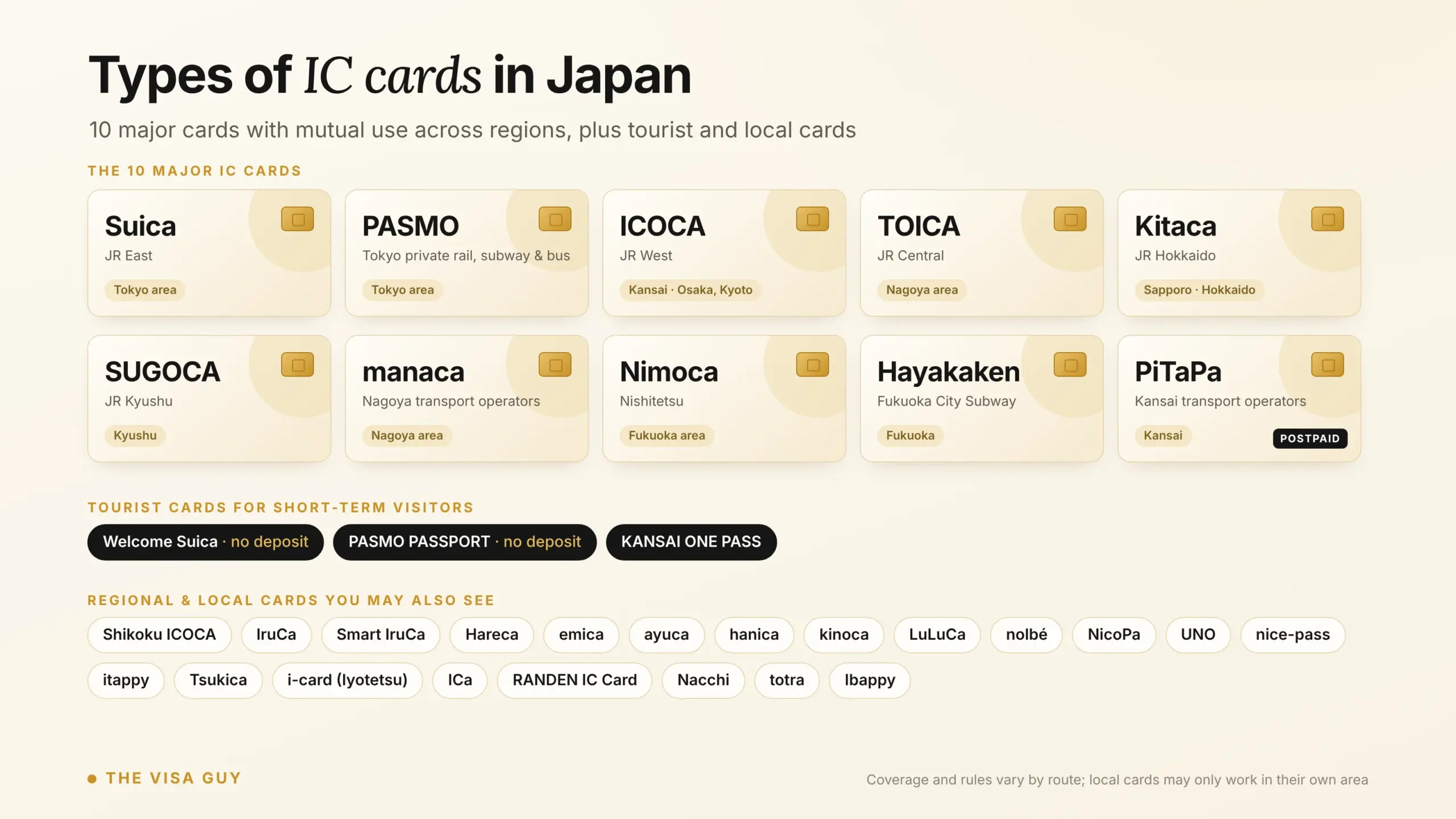
Japan has 10 major IC cards that travellers can use for public transport and cashless payments. Many of these cards work across different regions because Japan’s major transport IC card systems have a mutual-use arrangement. However, some routes and areas may not accept every card.
- Suica: JR East issues Suica. You can use it mainly in the Tokyo area and on participating transport networks in other regions. Visitors can also use Welcome Suica, a special card designed for short-term travellers.
- PASMO: Private railway, subway, and bus operators in the Tokyo area issue PASMO. It works on many of the same transport networks as Suica. Visitors can also find tourist-focused PASMO options.
- ICOCA: JR West issues ICOCA. It is widely used in the Kansai region, including Osaka and Kyoto, and works on many participating networks across Japan.
- TOICA: JR Central issues TOICA. You can use it mainly around the Nagoya area and on participating transport services in other regions.
- Kitaca: JR Hokkaido issues Kitaca. It mainly serves the Sapporo area and other participating transport services in Hokkaido.
- SUGOCA: JR Kyushu issues SUGOCA. You can use it on participating trains, buses, and other transport services in Kyushu.
- manaca: Transport operators in the Nagoya area issue manaca. It mainly covers local subways, trains, and buses in the region.
- Nimoca: Nishitetsu issues Nimoca. You can use it mainly on participating trains and buses in the Fukuoka area and other supported locations.
- Hayakaken: Fukuoka City Subway issues Hayakaken. It is mainly used on the Fukuoka subway and other participating transport networks.
- PiTaPa: Transport operators in the Kansai region issue PiTaPa. Unlike most other major IC cards, PiTaPa generally works as a postpaid card rather than a prepaid card. This makes it different from cards such as Suica and ICOCA.
Can Qatar Travellers Use Any IC Card Across Japan?
Qatar residents can use major Japanese IC cards across many train, subway, and bus networks throughout Japan. Cards such as Suica, PASMO, ICOCA, TOICA, and Kitaca have mutual-use arrangements, so you generally do not need a different card for every city.
However, some local transport operators and remote routes may not accept every IC card, so check the transport operator before travelling to less-connected areas.
This is especially useful for Qatar residents planning a multi-city Japan trip. A card used in the Tokyo area may also work on participating transport networks in cities such as Osaka, Kyoto, and Nagoya.
However, IC cards do not cover every route across Japan. For example, some journeys that cross regional boundaries may require a separate ticket if the connected IC systems do not support the entire journey.
A standard IC card also does not automatically cover Shinkansen travel. If you plan to travel between major cities such as Tokyo, Kyoto, or Osaka, you need the appropriate Shinkansen ticket or an approved service that allows you to link your IC card to the journey.
Check the requirements for your specific route before travelling.
Qatar residents may also be able to add certain IC cards, such as Suica or PASMO, to a compatible smartphone wallet.
However, mobile IC card availability and payment options can depend on your phone model, operating system, region, and payment card. Check compatibility before your trip if you plan to rely on your phone instead of a physical card.
Short-term visitors can also consider tourist-focused options such as Welcome Suica. These cards are designed for international visitors and can be convenient for travellers who do not plan to use a regular long-term transport card.
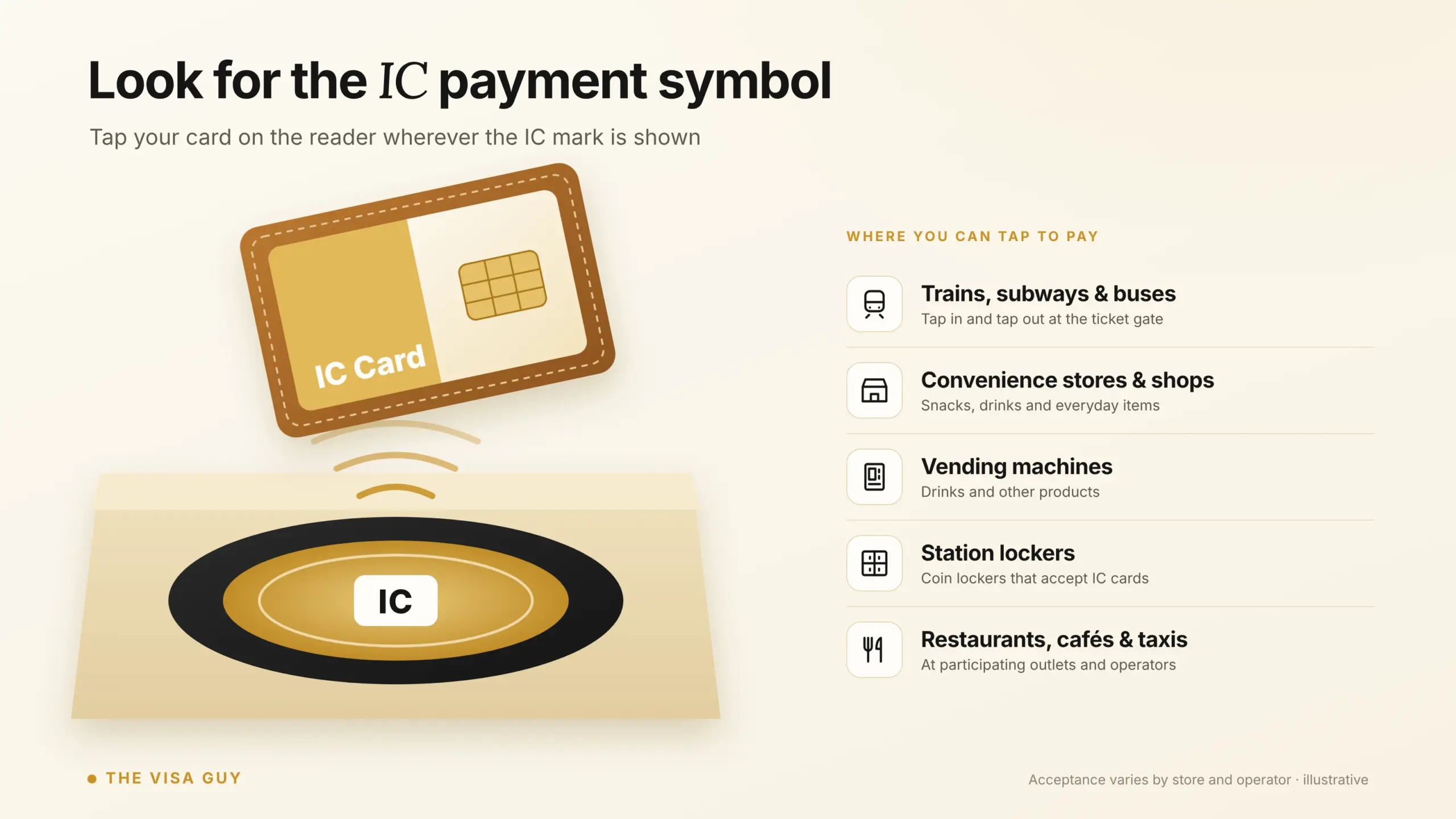
Beyond transportation, IC cards can also help with small everyday payments during your Japan trip. Participating convenience stores, vending machines, station lockers, restaurants, and other shops may accept IC card payments. Look for the relevant IC payment symbol before making a purchase.
Where Can You Buy an IC Card in Japan?
- Airport Arrival Halls: Buy tourist-friendly IC cards at selected airports after you arrive in Japan. This can be a convenient option if you plan to use public transport immediately.
- Major Train Stations: Many large train stations have IC card counters and machines where you can buy or obtain a card.
- Ticket Machines: Look for ticket machines that display the IC card logo. Follow the instructions on the screen to purchase or load a card.
- Convenience Stores: Some convenience stores sell or support IC card services. Availability can vary by location.
- Travel Service Counters: Major airports and some transport hubs have travel information counters that can help visitors with transport options.
- Before Leaving Qatar: Check which IC card options are available for your arrival airport and first destination. This helps you choose the most convenient option before your trip.
How to Recharge an IC Card
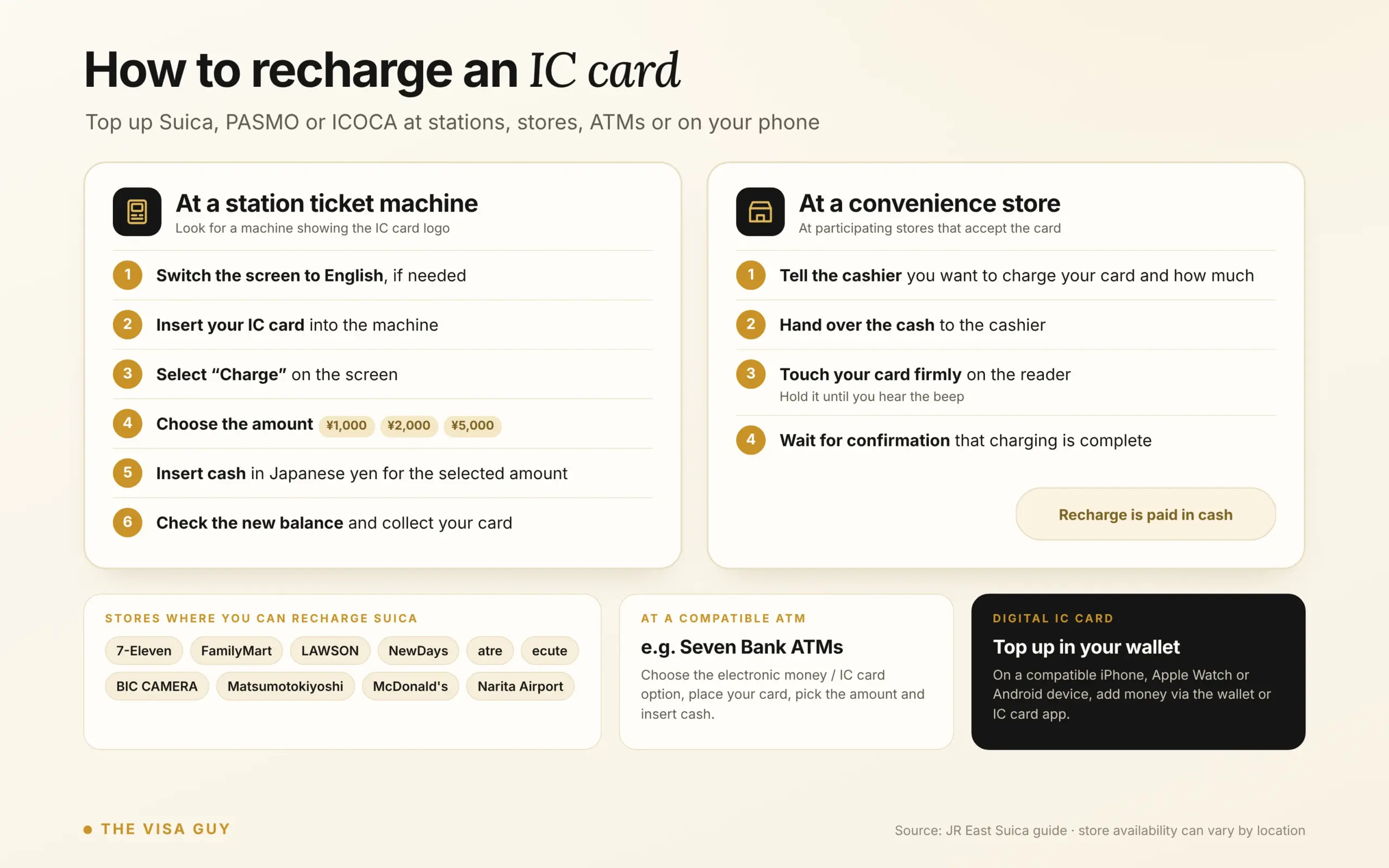
You can recharge an IC card such as Suica, PASMO, or ICOCA at train stations, convenience stores, and compatible ATMs. You can also add money to a digital IC card through a compatible smartphone wallet.
Recharging at Train Station Ticket Machines
- Look for a ticket machine or fare adjustment machine that displays the IC card logo.
- Switch the screen language to English, if needed.
- Insert your physical IC card into the machine or place it on the contactless reader.
- Select Charge or the relevant recharge option.
- Choose the amount you want to add, such as ¥1,000, ¥2,000, or ¥5,000.
- Insert the required amount of cash in Japanese yen.
- Check the updated balance and collect your card and any change or receipt.
Recharging at Convenience Stores
You can also recharge a physical IC card at participating convenience stores. Take your card to the cashier and ask to charge it. Tell the staff how much you want to add and pay in cash.
Many major convenience store chains offer IC card recharge services, including 7-Eleven, FamilyMart, Lawson, and NewDays. However, availability can vary by store.
Recharging at Compatible ATMs
Some ATMs also allow you to recharge compatible IC cards. For example, Seven Bank ATMs support IC card charging. Select the relevant electronic money or IC card option, place your card on the reader, choose the amount, and insert the cash.
Recharging a Digital IC Card
If you use a digital IC card on a compatible iPhone, Apple Watch, or Android device, you can add money through the supported wallet or IC card app. The available payment methods depend on your device, card, and payment settings.
Where Can You Recharge Suica?
Suica recharge is available at many locations across Japan, including train stations, convenience stores, and compatible ATMs. 7-Eleven, FamilyMart, Lawson, and NewDays are some examples of stores where you may be able to recharge your Suica. Availability can vary by location.
For a more detailed list of places where Suica recharge is available, see this Suica recharge guide.
What Can You Pay for With an IC Card?
You can use an IC card for many small payments during your Japan trip. Look for the IC card payment logo before paying.
- Convenience Stores: Pay for snacks, drinks, toiletries, and other everyday items at participating stores.
- Vending Machines: Buy drinks and other products from compatible vending machines.
- Station Lockers: Pay for coin locker services at stations that accept IC cards.
- Restaurants and Cafés: Some restaurants, cafés, and food outlets accept IC card payments.
- Shopping: Use your card at selected shops, supermarkets, and other retail stores.
- Taxis: Some taxis accept IC card payments, although availability varies by operator.
- Other Services: You may also find IC card payment options at places such as amusement facilities and other visitor services.
Can You Get a Refund for an IC Card in Japan?
You can get a refund for some regular physical IC cards at the offices of the company that issued the card. The refund rules depend on the type of card and the issuing company.
- Suica: You can return a regular Suica card at eligible JR East stations and offices in the areas they serve. You can receive the ¥500 deposit back, along with any remaining balance after the applicable handling fee.
- PASMO: You can return a regular PASMO card at eligible PASMO stations and offices operated by participating companies.
- ICOCA: You can return a regular ICOCA card through eligible JR West stations and offices.
- Tourist IC cards: Cards such as Welcome Suica and PASMO PASSPORT do not require a deposit and generally do not provide refunds for unused balances. Use the remaining balance before the card expires.
- Mobile IC cards: Digital versions of Suica and PASMO follow different refund rules. You generally cannot simply exchange the remaining digital balance for cash at a station.
- Return the card to the right operator: A physical IC card usually needs to be returned to the company that issued it. For example, you cannot normally return a Suica at an ICOCA service counter in Osaka.
Conclusion
Japan is a great country to visit because every season offers a different experience. Winter brings snow, skiing, and winter festivals. Spring is known for cherry blossoms, while summer and autumn also offer their own unique sights and activities.
For Qatar residents planning a trip to Japan, visa preparation should be part of the early planning. Check the latest requirements and prepare your documents carefully.
A Japan visa application can be refused, so check the reason for refusal and the current rules before making another application.
You should also plan how you will manage your daily travel in Japan. Before getting an IC card, check whether it works on the routes you plan to use.
Keep the card away from metal objects and avoid bending or damaging it. Do not keep more than one contactless card together in the same card holder, as the reader may not read the correct card.
It is also useful to carry some Japanese yen because not every transport service or shop accepts IC cards. With a little planning, you can avoid common problems and enjoy your Japan trip with fewer travel hassles.
FAQs
Which IC card is best for tourists visiting Japan from Qatar?
Suica, PASMO, and ICOCA are popular options for tourists. The best choice depends on where you start your trip and which transport networks you plan to use.
Can I use one IC card throughout Japan?
You can use many major IC cards across different regions in Japan. However, some local routes and services do not accept every IC card, so check your route before travelling.
What happens if my IC card runs out of balance during a trip?
You cannot use the card for a payment if the balance is not enough. You can recharge it at compatible train stations, convenience stores, or ATMs.
Is an IC card the same as the Japan Rail Pass?
No. An IC card is mainly used for local transport and small payments. The Japan Rail Pass is a separate rail pass designed for eligible travellers who want to use covered JR trains.
Can I use my IC card on buses and subways?
Yes. You can use major IC cards on many buses and subway systems in Japan. Check for the IC card symbol because some local services may not accept them.
Do IC cards expire?
Regular IC cards can have different validity rules depending on the card and its type. Tourist cards may have a shorter validity period, so check the expiry conditions when you buy the card.